
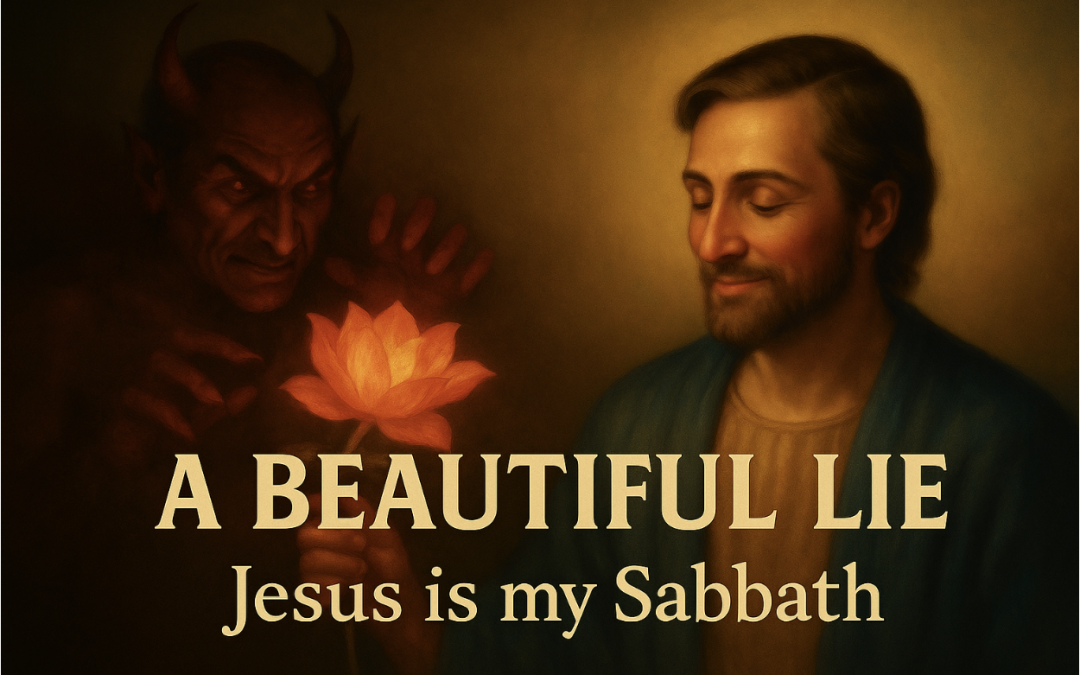
A Beautiful Lie
Romans 16:17–18 (KJV)
Now I beseech you, brethren, mark them which cause divisions and offences contrary to the doctrine which ye have learned; and avoid them. [18] For they that are such serve not our Lord Jesus Christ, but their own belly; and by good words and fair speeches deceive the hearts of the simple.
There is such a thing as an “ugly truth,” and there are also “ugly lies” that are easily recognized and rejected. More subtle is the beautiful lie, a claim that sounds spiritual and appears faithful, yet proves false when tested by Scripture.
This should be no surprise. The enemy often presents error attractively, framing it in language that appeals to believers who are inattentive to careful, prayerful study of the Word.
One such claim is the slogan, “Jesus is my Sabbath.” Some present it as a fresh theological insight, yet, the wise man wrote, “there is no new thing under the sun.” Variations of this idea can be found across church history. A few representative voices:
- Augustine of Hippo (354–430), On the Literal Meaning of Genesis: “The true Sabbath is the Lord our God Himself… The peace of contemplation is the seventh day…”
- Martin Luther (1483–1546), Larger Catechism: To keep the Sabbath holy is fundamentally to be sanctified by God’s Word and to rest in Him through the Gospel.
- Jonathan Edwards (1703–1758), History of the Work of Redemption: The Jewish Sabbath prefigured the rest of grace now and the glory to come.
- Modern Reformed writers (e.g., Michael Horton) similarly speak of Christ as the believer’s ultimate rest.
While these voices rightly exalt Christ as the ground of our rest, the contemporary slogan often goes further, functionally displacing the seventh-day Sabbath and minimizing its creation foundation. Below is a biblically reasoned response.
Beware of Attractive but Unscriptural Claims
We must not be overawed by respected names. No human teacher is infallible. Moreover, invoking the name of Jesus does not guarantee fidelity to the apostolic Gospel. Paul warns: “If he that cometh preacheth another Jesus… or another gospel… ye might well bear with him” (2 Cor. 11:4, KJV). Every claim must be tested by Scripture.
What the Slogan Gets Wrong
1) “Jesus is my Sabbath” is not a biblical statement.
Scripture establishes truth “in the mouth of two or three witnesses” (Matt. 18:16, KJV). Nowhere does the Bible identify Christ as “the Sabbath” in such a way that the weekly command is nullified. Christ indeed gives rest (Matt. 11:28), but no verse redefines the Sabbath commandment by equating the day itself with Jesus’ person.
2) it confuses the Lord of the Sabbath with the Sabbath itself.
Jesus declares: “The Son of man is Lord also of the sabbath” (Mark 2:28, KJV). To be Lord of the Sabbath implies authority over it, its origin, meaning, and right use—not identity as the Sabbath. John 1:1–3 links the Son with creation; Genesis 2:1–3 shows the Sabbath instituted at creation. Christ’s lordship over the day underscores His divinity; collapsing Lord and ordinance risks confusing symbol with substance.
3) it conflates spiritual rest with weekly Sabbath rest.
Hebrews 3–4 speaks of entering God’s rest—salvation rest now and eschatological rest to come—while still affirming: “There remaineth therefore a rest [sabbatismos] to the people of God” (Heb. 4:9, KJV). The author uses a distinctive term pointing to Sabbath-keeping as an ongoing reality for God’s people. In other words, resting in Christ and keeping the seventh day are complementary, not competitive.
4) It misreads Colossians 2 and Hebrews 4.
In Colossians 2:16–17, Paul refers to ceremonial sabbaths (annual feast days), not the seventh-day Sabbath of creation.
Check out this video for more on this subject.
The Sabbath days in Colossians
In Hebrews 4, the “rest” refers to entering God’s salvation rest and ultimately the future heavenly rest. But the text draws on the weekly Sabbath as a continuing sign and reminder of that rest. To say “Jesus is my Sabbath” oversimplifies the passage and ignores the layered meaning regarding the word (rest) and the various ways it has been used in the chapter. One thing to note, the word rest in Hebrew 4:9 is is the word σαββατισμός G4520 - sabbatismos https://iphone.blb.org/apk/Lexicon.cfm?Strongs=G4520&t=kjv&platform=ios
The Unique Word Choice (Sabbatismos): They argue that if the author of Hebrews intended to speak only of a spiritual, metaphorical rest (using the Greek word katapausis, which is used elsewhere in the chapter), he would have done so. Instead, he chose a special word that directly derives from the Sabbath (Sabbaton)
Greek lexicons (dictionaries) that define sabbatismos as "a keeping of a Sabbath" or "a Sabbath observance." The word "remains" (apoleipetai) indicates something that continues to exist for God's people. Neither Christ’s death or resurrection has abolished, if anything the writer of Hebrews is emphasizing the keeping of the Sabbath because of Jesus. Hebrews 4:9 (NIV): "There remains, then, a Sabbath-rest for the people of God."
For more on Hebrews 4, and the usage on the word rest. Click this link here. Does Rest in Christ Nullify the Keeping of the 7th day Sabbath?
Some non-Adventist scholars acknowledge the linguistic force of the word, even if they don't all draw the same theological conclusion about mandatory observance.
Kenneth A. Strand (Theologian and Church Historian):
"The term in Hebrews 4:9 is sabbatismos, which is not the usual Greek word for 'rest'... but has the specific connotation of 'sabbath observance' or 'sabbath rest.' This passage, therefore, appears to be a clear reference to the fact that the Sabbath commandment of the Decalogue has a continuing validity for the Christian."
Marvin R. Vincent (Word Studies in the New Testament, 1887):
"'A Sabbath-keeping'... The word here used, sabbatismos, is formed from sabbatizo, to keep Sabbath... The writer's meaning is that a Sabbath-rest remains for God's people. The blessing of the Sabbath rest is greater than that of the rest in Canaan, and is of a more enduring character."
A.T. Robertson (Word Pictures in the New Testament):
"There remains a Sabbath rest... The word is a rare one... from sabbatizō... to keep the Sabbath... So it seems best to see in this phrase the spiritual Sabbath rest which Christians enjoy."
John Owen (Puritan Theologian, acknowledging the word's meaning): Even John Owen, who strongly argued for the Christ-centered interpretation, had to concede the force of the term. In his massive commentary on Hebrews, he writes:
"Sabbatismos... is properly 'a Sabbath-keeping.'"
The Seventh-day Adventist Bible Commentary (on Hebrews 4:9):
"The use of the word sabbatismos... is strong evidence that the author is thinking of the weekly Sabbath... The word literally means 'Sabbath observance' or 'Sabbath keeping'... The writer here says that the Sabbath rest remains for the people of God. That is, the weekly Sabbath is still to be observed by Christians as a memorial of God's creative and redemptive rest."
- Samuele Bacchiocchi (Adventist Theologian, in From Sabbath to Sunday):
"The term sabbatismos... is a unique term which undoubtedly means 'Sabbath observance' or 'Sabbath celebration'... The author argues that the Sabbath rest 'remains'... because it is a type of the eternal rest which is still future. The Sabbath, therefore, is not abolished by the coming of Christ, but rather its meaning is enhanced."
5) It undermines creation order and God’s gift to humanity.
The Sabbath is not a post-Sinai Jewish invention. It is rooted in creation (Gen. 2:1–3) and declared a gift for humanity (Mark 2:27). Treating the day as obsolete deprives people of a divine blessing designed for communion, remembrance, and delight.
6) It creates a false either/or.
Scripture presents both daily rest in Christ and weekly Sabbath rest:
- Spiritual rest = trusting Christ’s finished work, by grace through faith.
- Sabbath rest = a weekly sign of loyalty and sanctification, a rehearsal of eternal rest.
To say, “Jesus is my Sabbath, therefore the day is unnecessary,” is akin to saying, “Jesus is the bread of life, therefore the Lord’s Supper is unnecessary.”
7) It risks redefining obedience as optional.
If the fourth commandment is dismissed under the banner of “Jesus is my Sabbath,” selective obedience follows. But James writes, “Whosoever shall keep the whole law, and yet offend in one point, he is guilty of all” (Jas. 2:10, KJV). The moral law is a unified expression of God’s will.
In Conclusion
If “Jesus is my Sabbath” means the fourth commandment no longer applies, then obedience becomes selective. By the same logic, someone could say, “Jesus is my truth, so lying doesn’t matter” or “Jesus is my life, so I don’t need the ‘do not murder’ command.” This undermines the moral law as a whole. And to break one is the same as breaking all. (Jam 2:10)
The teaching that “Jesus is my Sabbath” may sound humble, spiritual, and even beautiful, but it is in fact a counterfeit, an elegant lie designed to obscure God’s plain truth. The enemy has always wrapped deception in religious language to make it palatable, but beauty never transforms error into truth. Paul’s warning still rings true: “By good words and fair speeches [they] deceive the hearts of the simple” (Rom. 16:18).
Christ never replaced the Sabbath, He is Lord of the Sabbath (Mark 2:28). To say otherwise not only distorts Scripture, but also diminishes His authority as Creator and Lawgiver. Hebrews 4 does not abolish the Sabbath, it affirms that a Sabbath rest remains for the people of God (Heb. 4:9). To confuse spiritual rest in Christ with the weekly Sabbath is to substitute symbol for substance, grace for obedience, and truth for convenience.
God’s gift of the Sabbath, established at creation and confirmed by Christ, is not a burden but a blessing, a sign of His power to sanctify, a weekly reminder of salvation by grace, and a foretaste of the eternal rest to come. The false slogan “Jesus is my Sabbath” removes none of our responsibility, but it does rob us of the joy of God’s appointed day.
In the end, every Christian must choose: embrace the beautiful lie, or stand on the eternal Word. As Scripture declares, “There remains, therefore, a Sabbath rest for the people of God.” (Hebrews 4:9).